
📌 Table of Contents ⬆

Collagen: How Long to See Results? Timeline by Body Part
Collagen how long to see results is one of the most searched questions by anyone who just cracked open their first tub of collagen powder — and the frustration of waiting weeks without visible change is completely real. Here's the honest truth: collagen doesn't work overnight, but the science shows it absolutely does work — with studies recording measurable skin elasticity improvements in as little as 4 weeks at the right dose. The timeline, however, varies dramatically depending on which part of your body you're targeting, your age, your diet, and the type of collagen you're taking — and this post breaks down every single variable so you stop guessing and start seeing results.
For more information, see: NIH — Collagen and Skin Aging Research, Journal of Drugs in Dermatology — Oral Collagen Supplementation Review
📌 Quick Summary
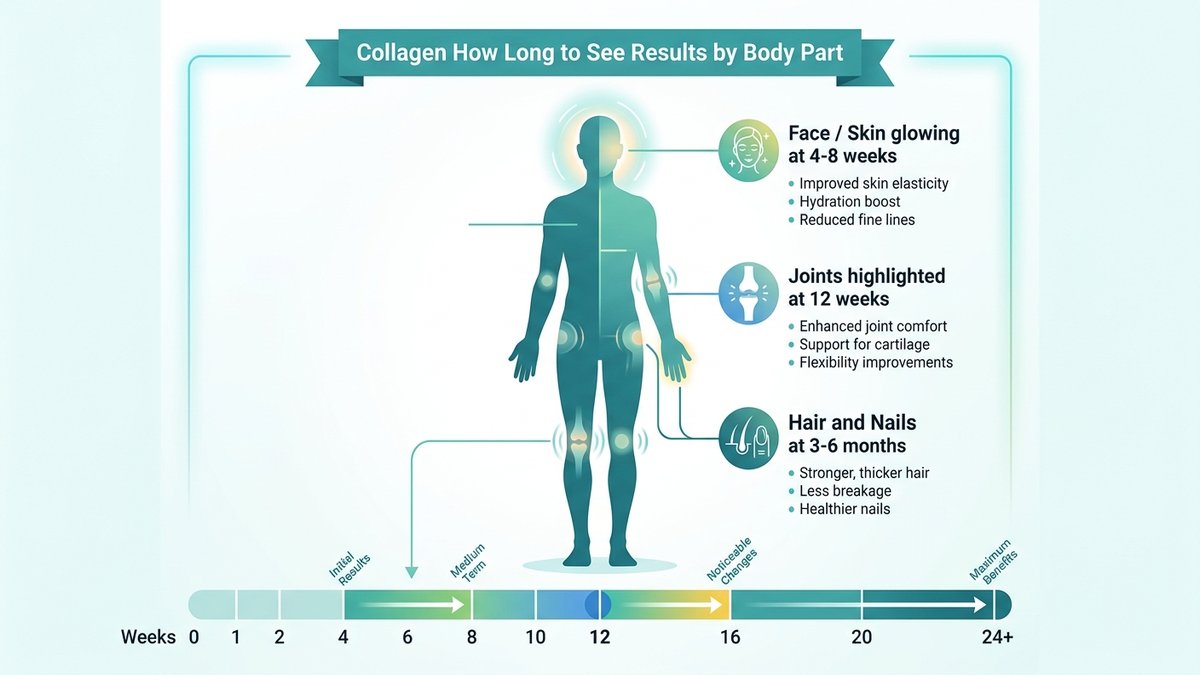
- Skin results appear fastest: Clinical studies show measurable improvements in skin elasticity and hydration within 4–8 weeks of daily collagen supplementation at 5–10g per day.
- Joint and bone benefits take longer: Research published in the *International Journal of Medical Sciences* found joint comfort improvements required a consistent 12-week supplementation window.
- Hair and nail growth follows a 3–6 month arc: Because hair growth cycles are slow, most users report noticeable thickness and reduced breakage only after 90–180 days of consistent use.
📊 Collagen How Long to See Results: The Complete Timeline by Body Part
Understanding collagen how long to see results requires recognizing that your body doesn't treat every tissue equally. Collagen is the most abundant protein in the human body, making up roughly 30% of total body protein, and it plays a structural role in skin, cartilage, bone, tendons, hair, and gut lining. When you supplement with hydrolyzed collagen (also called collagen peptides), those peptides are absorbed into the bloodstream and selectively delivered to tissues that need repair or reinforcement. The speed of delivery — and the speed of visible results — depends heavily on the tissue's natural turnover rate. Skin cells turn over relatively quickly compared to cartilage, which is why you'll notice skin changes weeks before you feel any difference in your knees. Knowing this fundamental biology is the first step toward setting realistic expectations and sticking with your supplement long enough to actually benefit from it.
According to a landmark 2019 systematic review published in the *Journal of Drugs in Dermatology*, which analyzed 11 randomized, controlled trials involving over 800 participants, oral collagen supplementation consistently improved skin elasticity, hydration, and dermal collagen density — but the timing of measurable change ranged from 4 to 24 weeks depending on the study design and outcome measured. For joints, a 2016 study in the *International Journal of Medical Sciences* found that athletes taking 10g of collagen hydrolysate daily for 24 weeks saw significant reductions in joint pain compared to placebo. Hair and nails, governed by slower biological cycles, showed improvement primarily in studies running 90 days or longer. The takeaway is clear: collagen supplements results by body part are not uniform, and patience calibrated to the right timeline is the key to success.
Skin Glow
Visible hydration boost in as little as 4 weeks
Joint Comfort
Pain reduction typically noticed around week 8–12
Hair & Nails
Thickness and strength emerge after 3–6 months
| Body Part | First Signs Appear | Full Benefit Timeline | Recommended Daily Dose |
|---|---|---|---|
| Skin (hydration) | 4–6 weeks | 8–12 weeks | 5–10g collagen peptides |
| Skin (elasticity/wrinkles) | 6–8 weeks | 12–24 weeks | 10g collagen peptides |
| Joints & Cartilage | 8–10 weeks | 12–24 weeks | 10g collagen hydrolysate |
| Hair growth & thickness | 8–12 weeks | 3–6 months | 5–10g + biotin support |
| Nails (strength) | 4–6 weeks | 3–4 months | 5g collagen peptides |
| Gut lining (leaky gut) | 2–4 weeks | 8–12 weeks | 10–20g collagen or gelatin |
💡 Key takeaway: Skin shows collagen results fastest (4–8 weeks), while joints and hair require 12–24 weeks of consistent daily supplementation for meaningful, measurable change.
🎯 How Long Does Collagen Take to Work for Skin, Joints, and Hair — Step by Step
If you've been wondering how long does collagen take to work for skin, the answer is more nuanced than most supplement labels admit. Your skin's dermis — the deep structural layer where collagen fibers live — doesn't refresh overnight. When you consume hydrolyzed collagen, studies show that specific di- and tri-peptides (like Pro-Hyp and Hyp-Gly) reach the dermis within hours of ingestion. However, the fibroblast cells that receive these peptides need time to respond by synthesizing new collagen fibers, improving moisture retention, and reducing fine-line depth. This is a biological construction project, not a cosmetic filter. The good news is that skin has one of the fastest collagen turnover rates among all body tissues, which is why it's also the first place most people notice results — often starting with a subtle improvement in skin moisture and 'plumpness' around the 4-to-6-week mark.
For joint health, the timeline question — when will I notice collagen working for joints and hair — demands even more patience. Cartilage is avascular (it has no direct blood supply), meaning nutrients reach it slowly through synovial fluid. This biological reality explains why joint-focused collagen studies consistently run for a minimum of 12 to 24 weeks. Hair operates on the anagen (growth), catagen (transition), and telogen (resting) cycle, which averages 2 to 6 years for a full cycle — meaning meaningful hair thickness improvements require at least one to two full growth cycles to be noticeable, typically around the 3-to-6-month mark with consistent supplementation. Understanding these biological timelines isn't discouraging — it's empowering, because it tells you exactly when to evaluate your results rather than quitting too early.
Start with the Right Type and Dose
Not all collagen is created equal, and type matters enormously for your target outcome. Type I collagen (found in marine and bovine hide sources) is most effective for skin and nails. Type II collagen (from chicken sternum) is specifically validated for joint and cartilage health. Type III often pairs with Type I for gut and vascular support. Clinical studies showing real results typically use 5–10g of hydrolyzed collagen peptides daily, with some joint studies using as much as 15g. Avoid underdosed products — many popular drinks and beauty powders contain only 1–2g per serving, which is well below the therapeutic threshold. Read your supplement label carefully and aim for a product where collagen peptides are the first ingredient, with a molecular weight under 5,000 Daltons for optimal absorption.
Take Collagen Consistently Every Day
The single biggest reason people feel collagen 'doesn't work' is inconsistent use. Every clinical trial showing positive outcomes required daily supplementation — not 3 or 4 days per week. Your body has no mechanism to 'save up' collagen peptides for later; it processes what it receives each day and uses it in real time. Missing days doesn't just pause progress — it can actually reset the early fibroblast stimulation process in skin tissue. Set a daily reminder, add your collagen to your morning coffee or smoothie (hydrolyzed collagen is heat-stable and flavorless), and commit to a minimum 90-day trial window before evaluating results. Think of it like compound interest: small daily deposits create significant structural returns over weeks and months, not days.
Pair Collagen with Vitamin C
This is one of the most critical — and most overlooked — steps in optimizing collagen how long to see results. Your body cannot synthesize collagen without Vitamin C as a co-factor. Vitamin C is essential for the hydroxylation of proline and lysine, two amino acids that form the triple-helix structure of collagen fibers. Without adequate Vitamin C, even the highest-quality collagen supplement will produce suboptimal results. A 2017 study in the journal *Nutrients* found that combining collagen peptides with Vitamin C significantly enhanced collagen synthesis compared to collagen alone. Aim for at least 80–100mg of Vitamin C taken alongside your collagen dose — a small glass of orange juice, half a bell pepper, or a dedicated Vitamin C supplement all work effectively. This one addition can meaningfully accelerate your visible timeline.
Track Progress Methodically for Each Body Part
Because collagen supplements results by body part arrive at different times, tracking each area separately prevents the common mistake of concluding the supplement 'isn't working' for everything because you haven't seen hair changes at week 6. Take a baseline photo of your skin (same lighting, same time of day) on Day 1, then repeat every 4 weeks. For joints, use a simple pain scale (0–10) and log it weekly. For nails, measure the length of one nail weekly with a ruler. For hair, photograph your hairline or part width monthly. This systematic approach does two things: it gives you objective data that overrides subjective memory (which tends to underestimate slow change), and it keeps you motivated during the plateau phases that happen between weeks 6 and 10 for most people before a more noticeable leap in results.
⚖️ Collagen Supplements: Real Benefits vs. Honest Limitations
The collagen supplement market is projected to reach $7.5 billion globally by 2027, and with that kind of commercial momentum comes a lot of hype that outpaces the science. The good news is that the science is actually quite solid — but it's also more specific and time-bound than most marketing suggests. Understanding the genuine pros and cons of collagen supplementation is critical so you can make an informed decision, set the right timeline expectations, and avoid the trap of abandoning a supplement that would have worked if given another four to six weeks. This section lays out what the research actually supports, where the limitations are real, and what red flags to watch for when evaluating your own response. Being a savvy collagen user means understanding both sides of the evidence — not just the before-and-after testimonials on Instagram.
One of the most important honest limitations to understand is that collagen supplementation works best as a support system, not a standalone miracle. Your body's collagen production naturally declines at a rate of about 1% per year after age 21, and by your 40s and 50s, that deficit is significant enough that supplementation becomes genuinely meaningful. However, factors like smoking, chronic UV exposure, high sugar intake, and sleep deprivation all accelerate collagen degradation faster than supplements can compensate. A person who smokes a pack a day and sleeps five hours while taking collagen will see far slower — and less durable — results than a non-smoker with healthy sleep habits and the same supplementation protocol. Collagen supplements work most powerfully when they're part of a broader lifestyle that doesn't actively destroy the collagen you're trying to build.
Pros
- ✅ Clinically validated for skin: A 2019 meta-analysis of 11 RCTs confirmed significant improvements in skin elasticity and hydration with oral collagen — with 73% of studies showing statistically significant results.
- ✅ Joint pain relief with real data: A Penn State University study found athletes taking 10g collagen hydrolysate daily for 24 weeks reported significantly less joint pain during activity compared to the placebo group.
- ✅ Nail strength improvement: A 2017 study in the *Journal of Cosmetic Dermatology* found that 64% of participants saw improved brittle nail condition after 24 weeks of 2.5g daily collagen peptides.
- ✅ Generally safe and well-tolerated: Hydrolyzed collagen has a strong safety profile with no established upper limit for toxicity; most side effects (mild bloating, fullness) resolve within the first 1–2 weeks.
Cons
- ❌ Not a quick fix: Meaningful results require 4–24 weeks of consistent use depending on the body part — anyone promising overnight transformation is selling hype, not science.
- ❌ Quality varies wildly: The supplement industry is not tightly regulated; many products are underdosed (under 5g per serving) or use collagen sources with poor bioavailability, dramatically affecting how soon collagen shows effects.
- ❌ Dietary factors can negate results: High sugar intake accelerates glycation, which stiffens and damages collagen fibers — supplementing while maintaining a high-glycemic diet significantly blunts results.
⚠️ Important tip: Always choose a collagen supplement that is third-party tested (look for NSF, Informed Sport, or USP seals) and contains at least 5g of hydrolyzed collagen peptides per serving with a molecular weight under 5,000 Daltons for optimal gut absorption and delivery to target tissues.
✅ How to Maximize Your Collagen Results: The Lifestyle Stack That Accelerates Every Timeline
Knowing collagen how long to see results is only half the equation — the other half is actively optimizing the conditions under which your collagen supplement can do its best work. Think of collagen peptides as the raw building material and your daily lifestyle as the construction crew. Without the right crew, even the best materials sit unused. The most evidence-backed lifestyle factors that directly accelerate collagen synthesis include: adequate Vitamin C intake (minimum 75–90mg/day for adults per NIH guidelines), quality sleep of 7–9 hours (collagen synthesis peaks during deep sleep phases when growth hormone is released), resistance exercise (which mechanically stimulates fibroblasts to produce more collagen in tendons and skin), and sun protection (UV radiation is the single most destructive external force against skin collagen, degrading it faster than aging itself). Pairing these four habits with daily collagen supplementation can meaningfully compress the timeline — some users report visible skin changes as early as 3 weeks when all these factors align. For a deeper dive into building an evidence-based supplement routine that actually fits your lifestyle, check out our guide on [building a daily wellness supplement stack at InfoWellHub](https://infowellhub.com/daily-wellness-supplement-stack) — it pairs perfectly with everything covered here.
Beyond lifestyle, timing and form of collagen can also influence how soon collagen shows effects in your target areas. Research suggests taking collagen 30–60 minutes before exercise may enhance its uptake by tendons and cartilage — a finding specifically tested in the Penn State collagen-and-exercise study, where participants consumed collagen before activity rather than at a random time of day. For skin-focused goals, morning consumption paired with a Vitamin C-rich breakfast is a common protocol used in clinical trials with favorable outcomes. Marine collagen (sourced from fish skin) has a slightly smaller peptide size than bovine, which some researchers suggest may offer marginally faster absorption — making it a popular choice for those specifically targeting skin results. Ultimately, the best collagen form is the one you'll take every single day without fail, because consistency over 90+ days remains the single most predictive factor of visible success across every body part studied.
❓ Frequently Asked Questions
✍️ Final Thoughts: Your Next Step With Collagen
Collagen how long to see results is ultimately a question with a science-backed answer — and that answer is more empowering than most people expect. Skin hydration and early glow improvements can appear in as little as 4–6 weeks with a daily dose of 5–10g of hydrolyzed collagen peptides. Skin elasticity and fine-line reduction follow between weeks 8 and 24, depending on your age and lifestyle. Joint comfort improvements require a committed 12-to-24-week window, particularly for cartilage-dependent joints like knees and hips. Hair thickness and nail strength fall in the 3-to-6-month range, governed by your body's slower growth cycles. The most important takeaway from all of this is that collagen supplementation is not a short-game intervention — it's a long-game investment in your body's structural foundation. And the research consistently shows that people who stick with it long enough are rewarded with real, measurable, clinically documented results.
So here's your clear next step: Start today, track obsessively, and don't quit before week 12. Choose a high-quality collagen product with at least 5g of hydrolyzed Type I peptides per serving (Type II if joints are your focus), pair it with a Vitamin C-rich food or supplement, take it at the same time each day — preferably before exercise or with breakfast — and commit to a minimum 90-day trial before making any judgment about whether it's working. Take baseline photos of your skin, log your joint pain on a simple 0–10 scale, and measure one fingernail weekly. These small acts of objective tracking will reveal the gradual, real progress that daily mirror checks almost always miss. How soon collagen shows effects in your specific body depends on your biology, your lifestyle, and your patience — but the research is unambiguous that for people who stay consistent, results do come. Your collagen journey starts not when you see the results, but the moment you commit to the timeline required to get there.
Post a Comment