
📌 Table of Contents ⬆
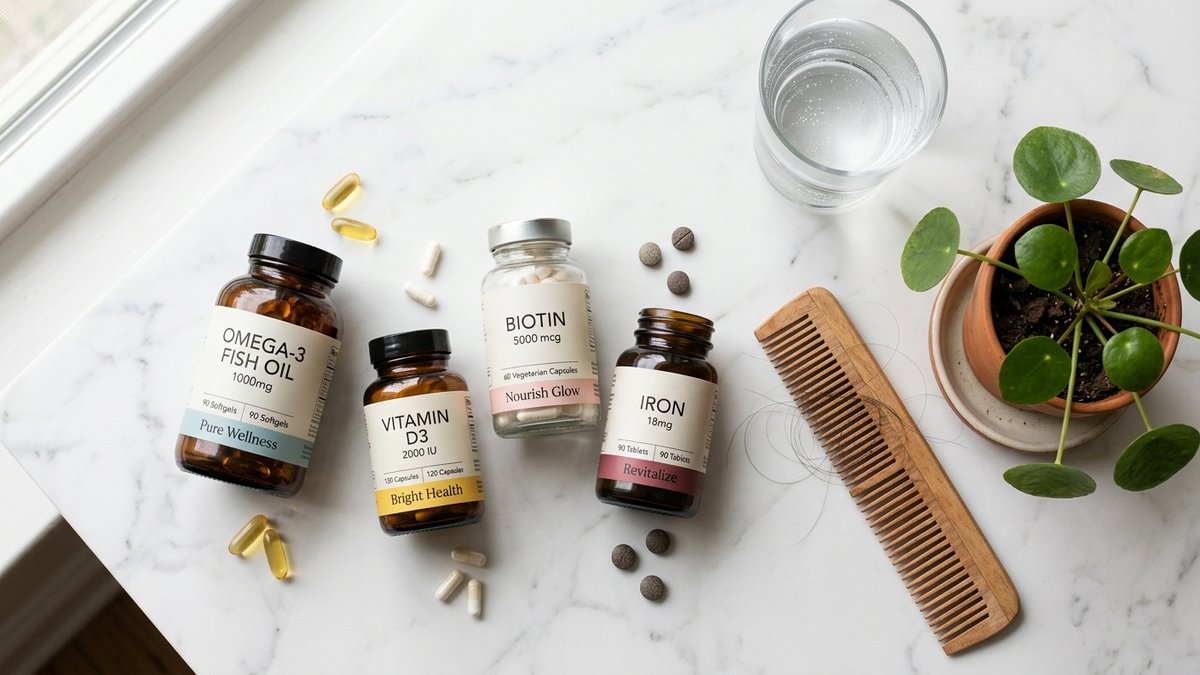
Hair Loss Supplements That Actually Work: Science-Backed Guide
Picture this: You're standing in the shower, watching what feels like half your hair swirl down the drain — again. You've already spent a small fortune on shampoos that promised miracles and delivered nothing. So you start Googling 'hair loss supplements that work,' and suddenly you're drowning in ads for miracle pills, celebrity-endorsed gummies, and ingredient lists that read like a chemistry exam. Here's the uncomfortable truth: the global hair loss treatment market hit $3.6 billion in 2023, and a massive chunk of that money goes toward products with little to no scientific backing. But some supplements genuinely do make a difference — and this guide exists to show you exactly which ones, why they work, and how to use them so you're not just throwing money at a problem and hoping for the best.
For more information, see: National Institutes of Health — Office of Dietary Supplements: Biotin Fact Sheet, American Academy of Dermatology — Hair Loss
📌 Quick Summary
- Science matters most: Only a handful of supplements — like biotin, iron, and saw palmetto — have meaningful clinical evidence behind them for hair loss support.
- Deficiency is often the root cause: Studies show up to 30% of hair loss cases in women are linked to nutritional deficiencies, especially iron and vitamin D.
- Consistency beats everything: Most effective hair loss supplements that work require at least 3–6 months of daily use before measurable regrowth or reduced shedding occurs.
📊 The Science Behind Hair Loss Supplements That Work
Before we talk ingredients, let's get one thing straight: not all hair loss is the same, and that matters enormously when choosing supplements. Androgenetic alopecia (pattern baldness) is driven by DHT, a derivative of testosterone. Telogen effluvium — the kind triggered by stress, illness, or crash dieting — is driven by nutrient depletion and hormonal disruption. Alopecia areata is autoimmune. Each type responds to different interventions. The reason most people waste money on supplements is that they grab whatever's trending without knowing *why* their hair is falling out in the first place. A supplement that's a game-changer for DHT-driven loss might do absolutely nothing for someone whose ferritin levels are tanked. This is the foundational insight that most listicles skip entirely — and it's why we're starting here.
Here's why this matters on a cellular level: hair follicles are some of the most metabolically active cells in your entire body. They need a continuous, high-quality supply of amino acids, minerals, and vitamins to produce keratin — the protein that makes up over 90% of your hair shaft. When your body is under stress, nutrients are redirected away from 'non-essential' functions like hair growth toward vital organs. That's why hair is often the first visible sign of a nutritional problem. The good news? It's also one of the first things to respond when you fix the deficiency. Research published in journals like *Dermatology and Therapy* confirms that correcting key deficiencies can meaningfully reduce shedding and support regrowth in people who are deficient — making natural supplements for hair loss and regrowth a genuinely viable strategy when used correctly.
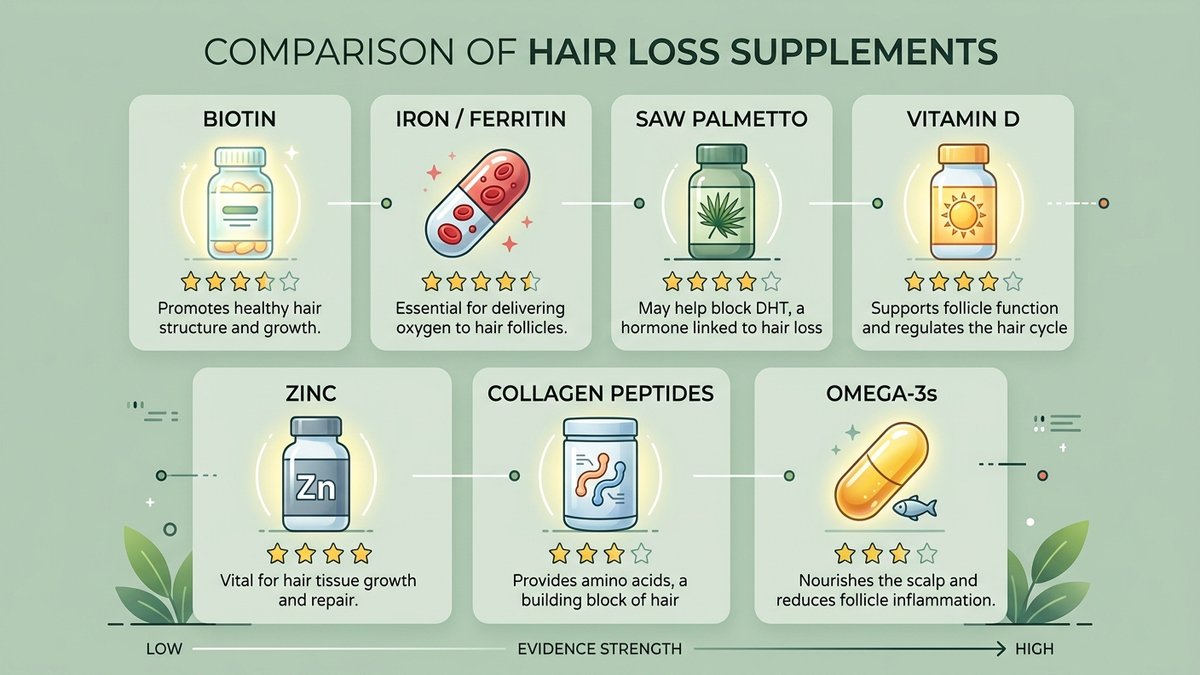
Biotin (B7)
Strengthens hair structure; deficiency causes shedding
Saw Palmetto
Blocks DHT — the hormone behind pattern hair loss
Iron + Ferritin
Low ferritin is a top hidden cause of female hair loss
| Supplement | Best For | Evidence Level | Typical Dose | Rating |
|---|---|---|---|---|
| Biotin (B7) | Brittle hair, deficiency-related loss | Moderate (strong if deficient) | 2.5–5mg/day | ⭐⭐⭐⭐ |
| Iron / Ferritin | Women with heavy periods, fatigue + shedding | Strong (when deficient) | Per blood test result | ⭐⭐⭐⭐⭐ |
| Saw Palmetto | DHT-driven pattern loss (men & women) | Moderate–Strong | 320mg/day standardized | ⭐⭐⭐⭐ |
| Vitamin D | Autoimmune-related loss, general thinning | Moderate | 1,000–2,000 IU/day | ⭐⭐⭐⭐ |
| Zinc | Excess shedding, slow regrowth | Moderate (if deficient) | 8–11mg/day (don't exceed) | ⭐⭐⭐ |
| Collagen Peptides | Hair shaft thickness, scalp health | Emerging | 2.5–10g/day | ⭐⭐⭐ |
| Omega-3 Fatty Acids | Scalp inflammation, follicle environment | Moderate | 1,000–3,000mg EPA/DHA | ⭐⭐⭐⭐ |
💡 Key takeaway: The most effective hair loss supplements that work are the ones that directly address *your* specific deficiency or hormonal trigger — not the ones with the flashiest marketing.
🎯 Best Vitamins for Thinning Hair: Ingredient-by-Ingredient Breakdown
Let's talk about the all-stars — the ingredients that actually show up in the clinical literature, not just in paid influencer posts. When researchers study the best vitamins for thinning hair in women (and men), a clear shortlist emerges. These aren't the only supplements worth considering, but they're the ones with enough peer-reviewed support to recommend without crossing our fingers. The key is understanding not just *what* they do, but *how* and *who* they help most — because taking the wrong supplement for your hair loss type is like taking allergy medication for a broken leg. Confident? Yes. Effective? Absolutely not.
What most people don't realize is that the interaction between these nutrients matters as much as the individual doses. For example, vitamin C dramatically increases iron absorption — so taking iron without vitamin C is significantly less effective. Zinc and copper compete for absorption, meaning mega-dosing zinc can actually deplete your copper levels and worsen hair loss. This is why a thoughtful, targeted stack almost always outperforms a single 'hair vitamin' gummy. Think of your supplement routine like a team — every player needs to know their role and complement the others.
Start with Biotin — But Only If You're Actually Deficient
Biotin is the most over-marketed hair supplement on the planet — and yet, it genuinely works when you need it. Here's the nuance most brands conveniently leave out: if you're not biotin-deficient (and most healthy adults eating a varied diet aren't), extra biotin won't magically accelerate your hair growth. However, true biotin deficiency causes brittle hair, thinning, and significant shedding — and supplementing in that case produces real, measurable results. A 2017 review in *Skin Appendage Disorders* found that in all reported cases of biotin supplementation for hair loss, there was an underlying biotin deficiency. So before you stock up on 10,000mcg gummies, it's worth knowing that biotin can also interfere with thyroid lab tests at high doses — something your doctor absolutely needs to know if you're supplementing.
Get Your Ferritin Tested Before Assuming Iron Is Fine
This is the one recommendation in this entire guide that could genuinely change your hair loss trajectory — and it's the one most people skip. Ferritin is your body's iron storage protein, and low ferritin is one of the most common — and most commonly missed — causes of hair loss in women. Standard iron panels often come back 'normal' while ferritin sits dangerously low. Most functional medicine practitioners recommend a ferritin level of at least 70 ng/mL for optimal hair growth, while conventional lab 'normal' ranges start as low as 12 ng/mL. If you're a woman experiencing hair loss and haven't had a ferritin test, that's your first action item. Don't self-supplement with high-dose iron without a test — excess iron is toxic and causes its own serious problems.
Consider Saw Palmetto for DHT-Driven Pattern Loss
If your hair loss follows a pattern — receding hairline, thinning at the crown, widening part — DHT is likely involved, and saw palmetto is one of the most promising natural supplements for hair loss and regrowth in this category. It works by inhibiting 5-alpha-reductase, the enzyme that converts testosterone into DHT. A notable 2020 study published in the *Journal of Alternative and Complementary Medicine* found that saw palmetto improved hair count by 35% over 12 months in men with androgenetic alopecia. The standardized extract dose is typically 320mg per day, and it's generally well-tolerated, though it can occasionally cause mild gastrointestinal issues. Women with hormonal hair loss may also benefit, but should consult a doctor before use, particularly if pregnant or on hormonal contraceptives.
Don't Overlook Vitamin D and Omega-3s for Scalp Health
Vitamin D receptors exist in hair follicles — and emerging research suggests that vitamin D plays a direct role in the hair growth cycle, specifically in creating new follicles. A 2019 study found significantly lower vitamin D levels in people with telogen effluvium and alopecia areata compared to controls. Given that 41.6% of American adults are vitamin D deficient according to research published in *Nutrition Research*, this is a gap worth closing. Pair vitamin D with omega-3 fatty acids (specifically EPA and DHA from fish oil or algae oil), which reduce scalp inflammation — one of the underrated contributors to follicle miniaturization. A 6-month randomized trial found omega-3 supplementation reduced hair loss and improved hair density in women. Together, these two create a powerful anti-inflammatory foundation for any effective hair loss supplement stack.
⚖️ Do Biotin Supplements Actually Help Hair Growth? Pros, Cons & Honest Verdict
Let's zoom in on biotin specifically, because it's the ingredient most people ask about — and the one with the biggest gap between hype and reality. Do biotin supplements actually help hair growth? The honest answer is: it depends entirely on why your hair is thinning. Biotin (vitamin B7) is essential for keratin production, the structural protein that makes up your hair. Without enough of it, your hair becomes brittle, thin, and prone to breakage. The problem is that biotin deficiency is relatively rare in the general population — most people get enough from eggs, nuts, and whole grains. So when a healthy person without a deficiency pops a high-dose biotin supplement and notices 'amazing results,' it's usually a combination of placebo effect, the simultaneous habit improvements that come with starting a wellness routine, or other nutrients in a multi-ingredient supplement doing the actual work.
That said, there are specific groups for whom biotin supplementation is genuinely impactful: people with biotinidase deficiency (a rare genetic condition), those on long-term anticonvulsant medications that deplete biotin, pregnant women (increased biotin demand), and heavy alcohol users. For everyone else, biotin is unlikely to be the hero ingredient — but it's also largely harmless at standard doses, which is why it dominates hair supplement marketing. The real issue is that taking high-dose biotin can falsely skew thyroid and cardiac biomarker lab tests, a FDA-issued warning that most supplement ads conveniently omit. Bottom line: biotin can be part of an effective hair loss supplement stack, but it probably shouldn't be the centerpiece unless you have a confirmed or suspected deficiency.
Pros
- ✅ Clinically significant when deficient: Correcting biotin deficiency produces rapid, measurable improvements in hair strength and growth cycle normalization.
- ✅ Widely available and affordable: High-quality biotin supplements cost as little as $10–$15/month, making them one of the most accessible hair loss supplements that work.
- ✅ Supports nail and skin health simultaneously: Biotin's role in keratin synthesis benefits nails and skin alongside hair, making it a multi-benefit addition to a supplement stack.
- ✅ Well-tolerated by most people: Biotin is water-soluble, so excess amounts are excreted in urine — making toxicity from typical doses essentially non-existent.
Cons
- ❌ Ineffective without a deficiency: For the majority of people with sufficient biotin intake, supplementing adds no measurable hair growth benefit — you're essentially paying for expensive urine.
- ❌ Lab test interference at high doses: The FDA has warned that biotin supplements exceeding 1mg can interfere with troponin and thyroid hormone tests, potentially masking serious conditions.
- ❌ Marketing confusion is rampant: Most 'biotin miracle stories' involve multi-ingredient formulas — biotin alone rarely deserves full credit, making it difficult to evaluate independently.
⚠️ Important: Before starting any new supplement for hair loss, get baseline bloodwork done — ferritin, vitamin D, zinc, thyroid (TSH, T3, T4), and a complete blood count. This single step will save you months of guessing and potentially hundreds of dollars spent on the wrong products.
✅ How to Build a Hair Loss Supplement Stack That Actually Works
Now that you understand the science, let's get practical. Building an effective supplement routine for hair loss isn't about grabbing every ingredient on this list — it's about strategic, personalized selection based on your specific hair loss pattern and lab values. Here's a realistic framework that most people can start with while waiting for full bloodwork results. Step one: start with the foundational trio — vitamin D (2,000 IU daily), omega-3 fatty acids (2–3g EPA/DHA daily), and a quality B-complex that includes biotin at a reasonable dose (around 1,000–2,500mcg, not the megadose 10,000mcg you see everywhere). These three address the most common nutrient gaps and support the overall follicle environment without risk of toxicity or lab interference. Give this baseline stack at least 90 days before evaluating. Hair growth cycles are long — the follicle you feed today won't produce visible hair for 3–4 months.
Once you have your bloodwork back, layer in targeted supplements based on what you find. Low ferritin? Work with your doctor on an iron repletion protocol — often iron bisglycinate (gentler on the stomach) paired with vitamin C at meals. Vitamin D below 40 ng/mL? Temporarily increase to 4,000 IU until levels normalize, then return to maintenance dosing. Pattern hair loss confirmed? Consider adding standardized saw palmetto extract (320mg daily) — one of the most evidence-backed natural supplements for hair loss and regrowth in the DHT category. For women specifically, research around marine collagen peptides (5–10g daily) is increasingly compelling for hair shaft thickness and scalp integrity. A 2018 double-blind, placebo-controlled study found a significant increase in hair growth parameters in women who supplemented with a marine-sourced protein complex over 90 days. Track your progress with monthly photos in consistent lighting — your eyes will deceive you, but the camera won't.
❓ Frequently Asked Questions
✍️ Final Thoughts: Your Hair Loss Supplement Action Plan
If you've made it this far, you're already ahead of the overwhelming majority of people who just grab the prettiest bottle off the shelf and hope for the best. Here's the most important thing to take away from this entire guide: the best hair loss supplements that work are always the ones matched to the actual reason your hair is thinning. There is no universal miracle formula. Biotin without a deficiency is mostly expensive urine. Iron without a confirmed low ferritin is potentially dangerous. Saw palmetto is brilliant for DHT-driven loss and irrelevant for stress-induced shedding. The supplement industry has spent billions of dollars convincing you that the solution is simpler than it is — and it's not in their interest to tell you to get bloodwork done before buying anything. But that honest, slightly inconvenient advice is what separates people who spend two years and $2,000 going nowhere from people who spend six months and see real, lasting change. You deserve the second outcome. The science is genuinely on your side — hair follicles are remarkably responsive to nutritional correction when given the right inputs.
Here's exactly what I'd do if I were starting today: First, book a lab panel that includes ferritin, full iron studies, vitamin D (25-OH), zinc, TSH/T3/T4, and a complete blood count. Many direct-to-consumer labs like Ulta Lab Tests offer these for under $100 without a doctor's visit. Second, while waiting for results, start the low-risk foundational stack: vitamin D3 (2,000 IU with a fatty meal), omega-3 fatty acids (2g EPA/DHA), and a quality B-complex with moderate biotin. Third, once results are back, layer in targeted supplements — iron bisglycinate with vitamin C if ferritin is low, saw palmetto if the pattern points to DHT, higher-dose vitamin D if levels are below 40 ng/mL. Fourth, commit to photographing your scalp monthly in consistent lighting and don't evaluate results until the 6-month mark. And finally — share this guide with someone else who's struggling, because the information gap around effective hair loss supplements that work is enormous, and knowledge is genuinely the first step toward real results. You've got this.
Post a Comment