
📌 Table of Contents ⬆

Best Probiotics for Women Over 50: Gut Health Guide 2026
Best probiotics for women over 50 are not a luxury — they are one of the most evidence-backed tools you can add to your daily wellness routine, especially when bloating, irregular digestion, and post-menopause gut changes are quietly wrecking your quality of life. After age 50, the diversity of beneficial bacteria in the gut can decline by up to 30–40%, according to research published in journals tracking the aging microbiome, leaving women more vulnerable to inflammation, weakened immunity, and nutrient malabsorption. This guide breaks down exactly which strains work, which products deliver real results in 2026, and what you should look for — so you can stop guessing and start feeling better.
For more information, see: NIH Office of Dietary Supplements — Probiotics Fact Sheet, Mayo Clinic — Probiotics and digestive health
📌 Quick Summary
- Strain specificity matters: Not all probiotics are equal — strains like *Lactobacillus acidophilus* and *Bifidobacterium longum* are clinically validated for women over 50 and address issues from bloating to immune modulation.
- CFU count is not everything: Research shows 10–50 billion CFUs is the sweet spot for most women over 50; going higher does not always mean better outcomes and can cause temporary discomfort.
- Menopause changes the rules: Declining estrogen alters the gut-vaginal microbiome axis, making probiotic strains like *Lactobacillus reuteri* especially valuable for women navigating perimenopause and postmenopause.
📊 Why the Best Probiotics for Women Over 50 Are Different From Generic Options
The best probiotics for women over 50 are fundamentally different from the one-size-fits-all bottles you see at the pharmacy checkout counter. After menopause, declining estrogen levels don't just affect hot flashes and bone density — they directly reshape the composition of the gut microbiome. A landmark study from the journal *Cell Host & Microbe* found that postmenopausal women had significantly lower populations of *Bifidobacterium* species compared to premenopausal women of similar health status. This shift contributes to slower gut motility (the reason so many women over 50 deal with constipation), increased intestinal permeability (often called 'leaky gut'), and heightened systemic inflammation. When you understand this hormonal-gut connection, it becomes clear why choosing age- and hormone-stage-appropriate probiotic strains is not optional — it is the entire point. Generic products loaded with just *Lactobacillus acidophilus* alone are missing at least half the picture for women in this life stage.
Beyond hormonal changes, aging also reduces stomach acid production — a condition called hypochlorhydria that affects roughly 30% of adults over 50, according to gastroenterology literature. Lower stomach acid sounds harmless, but it dramatically changes how probiotic bacteria survive their journey to the colon. This is exactly why enteric-coated capsules or acid-resistant delivery systems matter more for women over 50 than for younger adults. Additionally, medications commonly taken by women in this age group — including proton pump inhibitors, antibiotics, and metformin — significantly alter the gut microbiome baseline. A probiotic that helps a 30-year-old thrive may be completely irrelevant for a 58-year-old managing blood sugar and bone health simultaneously. The top-rated probiotic supplements for older women must account for all of these physiological realities to actually move the needle.
Gut-Immune Link
70% of immune cells live in your gut lining
Menopause Microbiome
Estrogen drop reshapes gut bacteria composition
Bloating Relief
Right strains cut bloating symptoms in 4–8 weeks
| Probiotic Strain | Primary Benefit for Women 50+ | Clinically Studied Dose | Key Feature |
|---|---|---|---|
| Lactobacillus acidophilus | Digestive balance, vaginal health | 1–10 billion CFU/day | Survives acid well |
| Bifidobacterium longum | Reduces bloating, bowel regularity | 5–20 billion CFU/day | Declines sharply with age |
| Lactobacillus reuteri | Bone density support, immune health | 100M–10 billion CFU/day | Estrogen-gut axis support |
| Bifidobacterium lactis (BB-12) | Immunity, constipation relief | 1–10 billion CFU/day | Most studied Bifido strain |
| Lactobacillus plantarum | Inflammation reduction, IBS symptoms | 10–20 billion CFU/day | Resilient; survives heat |
💡 Key takeaway: *Bifidobacterium* species decline most dramatically after 50 — prioritize products that include at least two *Bifidobacterium* strains alongside *Lactobacillus* varieties for comprehensive gut support.
🎯 How to Choose a Probiotic for Aging Women: A Step-by-Step Framework
Knowing how to choose a probiotic for aging women is the skill that separates women who get real results from those who waste money on ineffective products year after year. The supplement market is flooded with probiotic options — over 3,500 distinct probiotic products are currently sold in the US — but the vast majority are formulated without any clinical trials conducted specifically on women over 50. The good news is that evaluating a probiotic doesn't require a nutrition degree. It requires knowing four key checkpoints: the right strains, a viable CFU count at expiration (not just at manufacture), a delivery system that protects bacteria through stomach acid, and third-party testing verification. Once you know what to look for, the field narrows quickly from thousands of options to a manageable shortlist.
One underappreciated factor when learning how to choose a probiotic for aging women is the role of prebiotics in the same formula. Prebiotics — typically inulin, FOS (fructooligosaccharides), or chicory root — act as food for probiotic bacteria and can dramatically improve colonization rates in the gut. Research suggests that synbiotic formulas (probiotic + prebiotic combined) may outperform probiotic-only products by up to 40% in measurable gut microbiome changes over an 8-week period. For women over 50 dealing with bloating as a dominant symptom, however, starting slowly with prebiotic-containing products is wise — some prebiotics temporarily worsen gas and bloating before the gut adapts. Understanding this nuance is part of using the best probiotic supplement for women over 50 with bloating effectively.
Verify Strain Names (Not Just 'Lactobacillus')
Never buy a probiotic that only lists genus names like 'Lactobacillus' without the species and ideally the strain designation (e.g., *Lactobacillus rhamnosus* GG). The strain designation is where all the clinical evidence lives. Two products can both say 'Lactobacillus acidophilus' and have entirely different effects because they use different strains with different clinical histories. Look for strains with published human clinical trials — NCFM, GG, BB-12, and DSM 17938 are among the best-documented strains for digestive and immune health in women. Reputable brands will list the full strain name on the label or their website. If they don't, treat that as a red flag regardless of how appealing the marketing copy sounds.
Check CFU Count at Expiration Date
Many probiotic labels boast impressive CFU numbers — but that count is often measured at the time of manufacture, not when you actually consume the product. By the time a probiotic reaches you and sits in your cabinet, millions of those bacteria may already be dead. The best probiotics for women over 50 will explicitly state 'CFU guaranteed through expiration date' on the label. For women over 50, 10 to 50 billion CFU daily is generally the evidence-supported range for gut and immune benefits. Higher is not automatically better — extremely high CFU counts (above 100 billion) without medical supervision can cause temporary digestive upset, especially in women with sensitive guts post-menopause.
Choose Acid-Resistant Delivery Systems
As stomach acid production naturally decreases with age, the pH environment of the upper GI tract becomes less predictable — and for probiotic bacteria, surviving that journey to the colon is still far from guaranteed. Enteric-coated capsules or delayed-release vegetable capsules are specifically designed to bypass stomach acid and dissolve in the small intestine, dramatically improving the number of live bacteria that actually reach your gut. Research from the *Journal of Applied Microbiology* showed that enteric coating can improve probiotic survival rates by up to 10-fold compared to standard capsules. When evaluating the best probiotic supplement for women over 50 with bloating or irregular digestion, this delivery detail is often the difference between a product that works and one that simply doesn't.
Confirm Third-Party Testing and Certifications
The supplement industry in the US is lightly regulated compared to pharmaceuticals, which means what's on the label isn't always what's in the bottle. A 2019 investigation found that a significant portion of probiotic products tested contained fewer live organisms than stated. To protect yourself, look for products with third-party verification from organizations like NSF International, USP (United States Pharmacopeia), or Informed Sport. These certifications confirm that the product contains what it claims, is free from harmful contaminants, and was manufactured under proper quality controls. For women over 50 who may also be managing other health conditions and taking medications, this layer of verification is not just smart shopping — it is a meaningful safety measure.
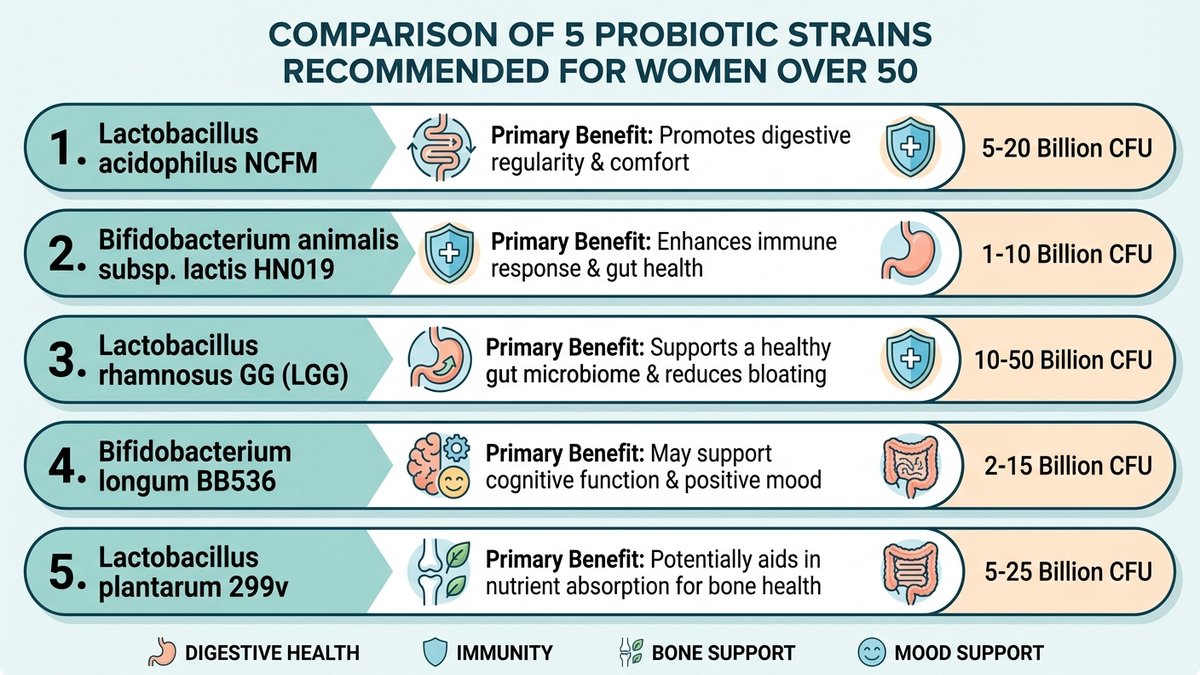
⚖️ Probiotic Strains for Menopause and Digestive Health: Pros, Cons & What the Research Really Says
When evaluating probiotic strains for menopause and digestive health, it's important to separate well-marketed claims from what the peer-reviewed evidence actually supports. The most robust clinical data for women in the 50+ age group centers on specific *Lactobacillus* and *Bifidobacterium* strains, with promising but still-emerging research on newer strains like *Akkermansia muciniphila* for metabolic health and gut barrier integrity. A 2023 systematic review published in *Nutrients* found that multi-strain probiotic formulas outperformed single-strain products in reducing bloating, improving bowel frequency, and supporting immune markers in postmenopausal women. The evidence for bone density support via *Lactobacillus reuteri* DSM 17938 is particularly notable — a randomized controlled trial found that supplementation over 12 months reduced bone loss rate by nearly 50% in older women, a finding that has significant implications for women navigating osteoporosis risk after 50.
The honest picture also includes limitations that many probiotic marketing materials conveniently skip. Probiotic effects are not permanent — most studies show that beneficial bacteria don't permanently colonize the gut; they exert their effects while present and gradually decline after supplementation stops. This means consistency is non-negotiable: taking a probiotic three times a week or stopping after two weeks is unlikely to deliver meaningful results. Additionally, women with specific conditions including SIBO (Small Intestinal Bacterial Overgrowth), immune-compromising conditions, or active inflammatory bowel disease should always consult a gastroenterologist before starting any probiotic regimen. The best probiotics for women over 50 are genuinely beneficial for the majority — but 'majority' does not mean 'everyone,' and individual response varies based on existing microbiome composition.
Pros
- ✅ Clinically supported bloating relief: Multi-strain formulas reduce bloating symptoms in 60–70% of postmenopausal women within 4–8 weeks of consistent use, based on clinical trial data.
- ✅ Immune modulation: *Bifidobacterium lactis* BB-12 has been shown in multiple trials to reduce the incidence and duration of upper respiratory infections, especially relevant for women over 50 whose immune response naturally slows.
- ✅ Bone density support: *Lactobacillus reuteri* supplementation showed a statistically significant reduction in bone loss rate in a 12-month RCT, offering a non-pharmaceutical adjunct for women managing osteopenia.
- ✅ Mood and cognitive benefits: The gut-brain axis research is compelling — *Lactobacillus helveticus* and *Bifidobacterium longum* combinations have shown reductions in anxiety scores and improvements in sleep quality in menopausal women in preliminary studies.
Cons
- ❌ Effects are not permanent: Probiotic bacteria do not permanently colonize the gut; consistent daily supplementation is required to maintain benefits, which adds ongoing cost and routine.
- ❌ Initial digestive adjustment period: Many women experience temporary increases in gas, bloating, or loose stools during the first 1–2 weeks of starting a new probiotic — particularly products with high prebiotic fiber content.
- ❌ Not universally safe: Women with SIBO, active IBD flares, or compromised immune systems may experience worsened symptoms, and clinical supervision is essential before starting supplementation in these cases.
⚠️ Important tip: Always introduce a new probiotic gradually — start with half the recommended dose for the first week to allow your gut microbiome to adjust, minimizing the risk of bloating or discomfort during the transition period.
✅ Best Probiotic Supplement for Women Over 50 With Bloating: 2026 Top Picks and Buying Guide
Finding the best probiotic supplement for women over 50 with bloating specifically requires narrowing the field based on both strain selection and formulation quality. Based on 2026 clinical evidence and third-party testing records, several products consistently stand out. Culturelle Women's Healthy Balance uses *Lactobacillus rhamnosus* GG — one of the most studied strains in the world — alongside additional strains targeting vaginal and digestive health. Garden of Life Dr. Formulated Women's Probiotic offers 50 billion CFU across 16 strains including multiple *Bifidobacterium* species, uses delayed-release capsules, and is certified USDA Organic with NSF verification. Renew Life Women's Care Ultimate Flora targets bloating directly with a clinically relevant dose of *Bifidobacterium lactis* and *Lactobacillus acidophilus*, both of which have strong evidence for improving bowel regularity and reducing gas production in older adults. Seed DS-01 Daily Synbiotic takes a science-forward approach with a nested capsule delivery system, 24 clinically studied strains, and transparent third-party testing — making it one of the most rigorously formulated options available in 2026. Each of these products earns its place by combining the right probiotic strains for menopause and digestive health with verified quality standards.
Beyond choosing the right product, when and how you take your probiotic significantly impacts effectiveness. Research consistently shows that taking probiotics with a meal or 30 minutes before eating — rather than on an empty stomach — improves bacterial survival through the GI tract because food buffers stomach acid. Pairing your probiotic with prebiotic-rich foods like garlic, onions, asparagus, bananas, and oats can further boost colonization. Consistency over a minimum of 4–8 weeks is the threshold most clinical trials use to measure outcomes, so commit to at least two months before evaluating whether a product is working for you. It's also worth noting that if you've recently taken antibiotics, starting a high-quality multi-strain probiotic within 2 hours after your antibiotic dose (or as directed by your doctor) can help protect existing gut bacteria populations during the treatment period. For women navigating gut health as part of broader menopause wellness, exploring our related guide on [gut-friendly nutrition strategies](https://infowellhub.com/gut-health-nutrition-guide) can help you build a complete foundation alongside your probiotic regimen.
❓ Frequently Asked Questions
✍️ Final Thoughts: Your Next Step Toward Better Gut Health After 50
The best probiotics for women over 50 are not a wellness trend — they are a scientifically grounded response to real, documented physiological changes that happen in the gut after menopause. The key findings from this guide come down to four non-negotiables: choose multi-strain formulas that include both *Lactobacillus* and *Bifidobacterium* species (because *Bifidobacterium* declines are the defining microbiome shift after 50); verify your product guarantees CFU counts through the expiration date, not just at manufacture; select enteric-coated or delayed-release delivery systems to maximize bacterial survival through an aging GI tract; and confirm third-party testing certification so you know the label reflects reality. The probiotic strains for menopause and digestive health with the strongest evidence — *L. acidophilus*, *B. longum*, *L. reuteri*, *B. lactis* BB-12, and *L. plantarum* — are your shortlist when evaluating any product. Remember that consistency over a minimum of 4–8 weeks is required to see meaningful results, and pairing your supplement with prebiotic-rich foods amplifies the benefit significantly. This is not about buying the most expensive bottle or the one with the flashiest label — it's about making one well-informed, consistent choice that aligns with what the research actually says about aging, hormones, and gut health.
Your next step is simpler than you might think: start today, start with one quality product, and track your symptoms. Write down how often you feel bloated, your energy levels, and your digestive comfort before you begin. Then commit to a full 8-week trial with a product that checks all four boxes — the right strains, verified CFU count at expiration, acid-resistant delivery, and third-party testing. If you're managing specific concerns like post-menopausal bloating, the best probiotic supplement for women over 50 with bloating will include *Bifidobacterium lactis* and *Lactobacillus plantarum* as core strains — use that as your filter. Before starting, if you take any prescription medications or have an existing GI condition, a quick conversation with your doctor or a registered dietitian takes about five minutes and removes any uncertainty about interactions or contraindications. For additional support in building a complete gut health foundation, explore InfoWellHub's related content on nutrition for women over 50 and anti-inflammatory eating — because a probiotic works best when it's part of a broader strategy, not an isolated fix. According to the [National Institutes of Health Office of Dietary Supplements](https://ods.od.nih.gov/factsheets/Probiotics-HealthProfessional/), the evidence supporting specific probiotic strains for particular health conditions continues to grow, making this one of the most active and promising areas of nutrition research today. You have every reason to feel optimistic — and every tool you need to start making your gut health a real priority in 2026.
Post a Comment