
📌 Table of Contents ⬆
Best Vitamin D Supplements 2026: D3 vs D2, Dosage & Top Picks
Nearly 42% of American adults are vitamin D deficient, according to the National Health and Nutrition Examination Survey — and most of them have no idea. As we head into 2026, the supplement aisle has never been more crowded or more confusing, with dozens of brands promising optimal absorption, superior bioavailability, and clinically backed dosages. Whether you're trying to shore up bone health, support your immune system, or simply fill a nutritional gap your diet can't cover, choosing the best vitamin D supplements 2026 has real stakes for your long-term wellbeing.
For more information, see: NIH: Vitamin D, Healthline: Vitamin D
📌 Quick Summary
- D3 outperforms D2: Clinical studies show vitamin D3 (cholecalciferol) raises blood serum levels roughly 87% more effectively than D2 (ergocalciferol) over 12 weeks.
- Dosage matters enormously: Most healthy adults need 1,000–2,000 IU daily, but those who are deficient may require 4,000 IU or more under medical supervision.
- Fat-soluble formulation is key: Vitamin D is fat-soluble, so softgels with olive oil or MCT oil deliver significantly better absorption than plain powder capsules or tablets.
📊 D3 vs D2: What the Science Actually Says About the Best Vitamin D Supplements 2026
When you're searching for the best vitamin D supplements 2026, the very first decision you'll face is choosing between vitamin D3 (cholecalciferol) and vitamin D2 (ergocalciferol). These are not interchangeable, and the science is surprisingly clear about which one wins. A landmark 2011 meta-analysis published in the *American Journal of Clinical Nutrition* found that D3 was approximately 87% more potent at raising and sustaining serum 25-hydroxyvitamin D levels compared to D2. D3 is the form your skin naturally synthesizes when exposed to UVB sunlight, which is why your body recognizes and utilizes it so efficiently. D2, on the other hand, is derived from plant sources like yeast and mushrooms, making it the go-to option for vegans and vegetarians. However, D2 converts less efficiently in the liver into the active hormone form (calcitriol), which means you'd need a higher dose of D2 to achieve the same blood levels as a lower dose of D3. For most Americans, D3 is the clear physiological winner — unless dietary ethics or restrictions make D2 a necessary alternative.
The marketplace reflects this scientific consensus in a big way. As of 2024 and into 2026, over 80% of vitamin D supplements sold in the United States contain D3, according to market analysis from Grand View Research. Brands like NatureMade, Thorne, NOW Foods, and Nordic Naturals have built their vitamin D lines almost exclusively around D3 formulations, often pairing them with vitamin K2 (MK-7) for enhanced calcium metabolism and cardiovascular protection. Research published in *Nutrients* (2020) confirms that the D3 + K2 combination helps direct calcium into bones rather than arterial walls — a critical distinction for anyone over 40. For vegan-friendly shoppers, lichen-derived D3 supplements (brands like Vitashine and Garden of Life mykind Organics) offer a plant-based D3 option that outperforms D2 while still meeting ethical standards. The bottom line: in 2026, your first filter when shopping for the best vitamin D supplement should be the form — and D3, whether animal- or lichen-derived, is almost always the superior choice for actual blood-level impact.
D3 vs D2 Winner
D3 raises serum levels 87% better than D2
Optimal Dose
1,000–2,000 IU daily for most healthy adults
Best Pairing
Take with K2 + fat for peak absorption
| Form | Source | Bioavailability | Best For |
|---|---|---|---|
| D3 (Cholecalciferol) | Lanolin / Fish Oil | Very High (~87% better) | Most adults, athletes |
| D2 (Ergocalciferol) | Yeast / Mushrooms | Moderate | Vegans (budget option) |
| Vegan D3 (Lichen) | Lichen plant | High (comparable to animal D3) | Vegans seeking best results |
| D3 + K2 Combo | Lanolin + Natto | Very High + synergistic | Adults 40+, bone/heart health |
| Liquid D3 Drops | Fish Oil base | High (fast absorption) | Children, elderly, malabsorption |
💡 Key takeaway: Vitamin D3 from lanolin or lichen-based sources consistently outperforms D2 in clinical blood-level measurements — making it the gold standard form in every top-rated supplement for 2026.
🎯 How to Choose the Right Dosage of Vitamin D in 2026
Dosage is arguably the most misunderstood aspect of vitamin D supplementation, and getting it wrong — in either direction — can have real health consequences. The National Institutes of Health (NIH) sets the official Recommended Dietary Allowance (RDA) at 600 IU per day for adults aged 19–70 and 800 IU per day for those over 70. However, leading vitamin D researchers and clinicians argue these figures are outdated and too conservative to move the needle for people who are actually deficient. The Endocrine Society suggests that adults may need 1,500–2,000 IU daily to maintain adequate serum levels above 30 ng/mL. For reference, the average American gets only about 230 IU per day from food alone, according to NHANES data — a significant gap that supplements must fill. Understanding where you fall on the spectrum requires a simple 25-hydroxyvitamin D blood test, which costs as little as $40–$60 and is covered by most insurance plans when ordered by a physician.
Toxicity is a real but rare concern that often stops people from supplementing adequately. The NIH's Tolerable Upper Intake Level (UL) is set at 4,000 IU per day for adults, though acute toxicity has been documented primarily at doses exceeding 10,000 IU per day over extended periods. Vitamin D toxicity — known as hypervitaminosis D — causes symptoms like nausea, weakness, frequent urination, and dangerous calcium buildup in the bloodstream. That said, the vast majority of Americans are far more at risk from under-supplementing than over-supplementing. A 2023 review in *JAMA Network Open* found that taking 2,000 IU daily of vitamin D3 for five years significantly reduced cancer mortality risk by 17% in participants without a cancer diagnosis at the start. The sweet spot for most healthy adults who don't get regular sun exposure sits between 1,000 and 2,000 IU daily, with higher doses reserved for those confirmed deficient via blood testing and supervised by a healthcare provider.
Get Your Baseline Blood Test First
Before buying a single bottle, invest in a 25-hydroxyvitamin D (25-OH-D) blood test. This is the gold-standard measurement for vitamin D status. Levels below 20 ng/mL indicate deficiency, levels between 20–29 ng/mL indicate insufficiency, and 30–100 ng/mL is considered optimal by the Endocrine Society. Most standard annual physicals don't automatically include this test, so you may need to request it specifically. Home testing kits from companies like Everlywell or LabCorp OnDemand now make this process easy and affordable — often ranging from $49–$79 without a doctor's visit. Knowing your baseline lets you dose precisely rather than guessing, which protects both your health and your wallet.
Match Your Dose to Your Deficiency Level
Once you have your blood results, calibrate your supplement dose accordingly. If your level is below 20 ng/mL (deficient), most clinicians recommend a loading protocol of 4,000–6,000 IU per day for 8–12 weeks before retesting. If you're insufficient (20–29 ng/mL), a daily dose of 2,000–3,000 IU is typically appropriate. For maintenance in people already at optimal levels (30+ ng/mL), 1,000–2,000 IU daily is usually sufficient, particularly during winter months when sun exposure drops. Always re-test every 3–6 months when you're in a correction phase. Your goal is a serum level in the 40–60 ng/mL range, which many vitamin D researchers consider the true optimum for immune, bone, and metabolic health.
Choose a Fat-Containing Formulation
Because vitamin D is fat-soluble, it needs dietary fat present in the gut to be properly absorbed into the lymphatic system. A clinical study published in the *Journal of the Academy of Nutrition and Dietetics* (2015) found that taking vitamin D with a high-fat meal increased absorption by up to 50% compared to taking it fasted. This is why softgel capsules suspended in oils like olive oil, sunflower oil, or MCT oil consistently outperform dry powder tablets in bioavailability. Products like Thorne Vitamin D/K2 Liquid, Nordic Naturals Vitamin D3, and NatureMade D3 Softgels all leverage this principle. If you're using a tablet or powder capsule, make sure to take it alongside a meal that contains healthy fats — avocado, nuts, eggs, or olive oil all work perfectly for this purpose.
Pair D3 with Vitamin K2 for Maximum Benefit
Taking vitamin D3 alongside vitamin K2 (specifically the MK-7 form) is one of the most evidence-backed supplement strategies in modern nutrition science. Vitamin D increases your body's absorption of calcium from the gut, but without adequate K2, that calcium can end up deposited in arteries and soft tissues rather than in your bones — a phenomenon sometimes called 'vitamin D paradox.' Vitamin K2 activates osteocalcin and matrix GLA protein, two proteins that shuttle calcium into bone and prevent arterial calcification. A typical well-formulated supplement pairs 2,000 IU of D3 with 100–200 mcg of K2 (MK-7). Brands like Jarrow Formulas MK-7, Life Extension D and K with Sea-Iodine, and Thorne D3-K2 have built strong reputations on this combination. If you're already on blood thinners like warfarin, consult your doctor before adding K2, as it can interact with anticoagulant therapy.
⚖️ Pros & Cons of the Most Popular Vitamin D Supplement Forms
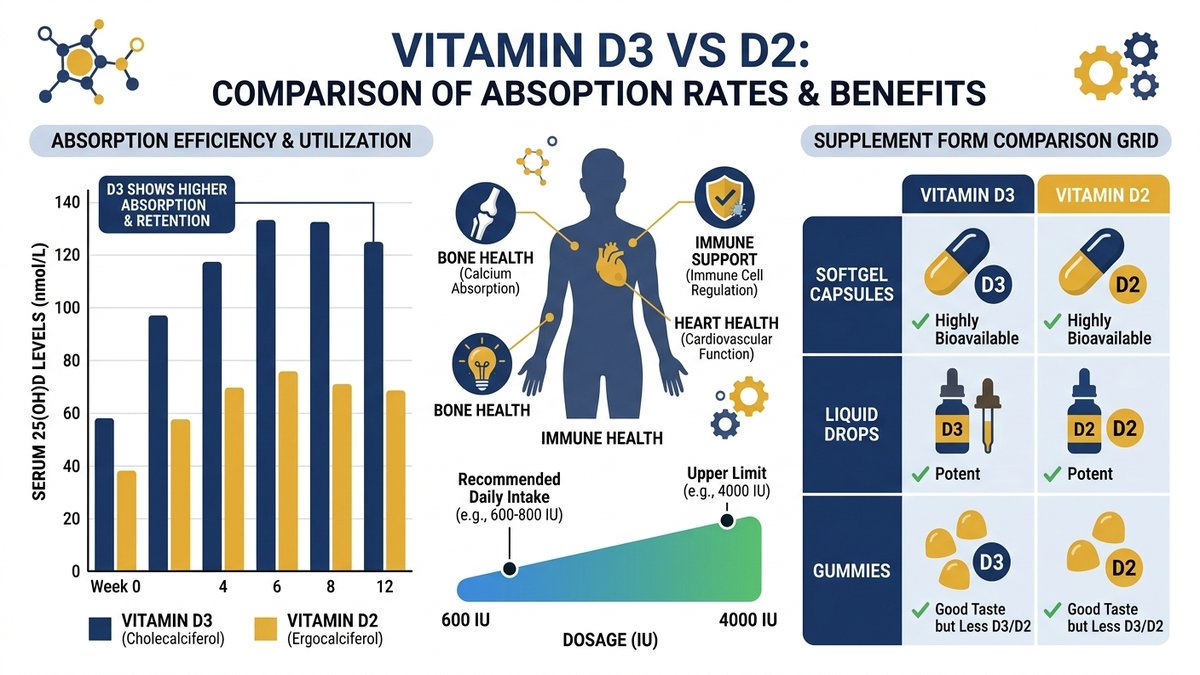
The supplement market in 2026 offers vitamin D in more delivery formats than ever before — softgels, liquid drops, gummies, powders, sublingual tablets, and even transdermal patches. Each format has genuine advantages and real drawbacks that can affect both how well the vitamin absorbs and how consistently you actually take it. Softgel capsules remain the gold standard for most adults because they encapsulate D3 in an oil-based medium that naturally supports fat-soluble absorption. However, they aren't appropriate for vegans (the gelatin shell is animal-derived), and some people with swallowing difficulties — particularly the elderly — find them hard to manage. Liquid drops are an excellent alternative for children, older adults, and anyone who struggles with pills; they're also easy to dose precisely and mix into food or beverages. The tradeoff is that liquids require careful storage, have shorter shelf lives, and can be easy to overdose accidentally if you're not measuring carefully.
Gummy vitamins have exploded in popularity — the US gummy supplement market reached $4.8 billion in 2023 — but they come with a significant caveat for vitamin D specifically. Most gummies use less bioavailable forms and lower doses, often topping out at 1,000–2,000 IU, and they frequently contain added sugars (often 2–5g per serving) that make them a poor choice for diabetics, keto dieters, or children prone to dental issues. Additionally, gummy format makes it harder to combine D3 with K2 effectively, since K2 is an oil-soluble compound that doesn't integrate well into gummy matrices. For anyone who prioritizes efficacy over convenience, softgels or liquid drops are almost always the smarter choice. That said, if a gummy is the only format you'll actually take consistently, a mediocre-absorbing supplement beats no supplement at all — consistency is the ultimate driver of results when it comes to correcting long-term nutrient deficiencies.
Pros
- ✅ Softgels offer superior bioavailability: Oil-based capsules consistently deliver the highest absorption rates in clinical comparisons, with some studies showing 32–50% better uptake than dry tablets.
- ✅ Liquid drops allow precise micro-dosing: Ideal for children and elderly individuals, liquid D3 lets caregivers dial in exact doses — especially useful when correcting significant deficiency under medical supervision.
- ✅ Gummies improve adherence: For adults and children who resist swallowing pills, gummies dramatically improve daily compliance — and consistent low-dose supplementation beats sporadic high-dose supplementation in long-term outcomes.
- ✅ D3 + K2 combos reduce cardiovascular risk: Combined formulations address both bone density and arterial health simultaneously, saving cost and simplifying routines for adults over 40.
Cons
- ❌ Gummies contain added sugars: Most commercial vitamin D gummies add 2–5g of sugar per serving, making them inappropriate for diabetics, low-carb dieters, or young children with dental concerns.
- ❌ Softgels are not vegan-friendly: Standard softgel capsules are made from animal-derived gelatin — shoppers following plant-based diets must specifically seek out vegan capsule alternatives, which are less widely available.
- ❌ Liquid drops risk accidental overdose: Without careful measurement, liquid vitamin D supplements are easy to over-administer — particularly dangerous with children, where dosing precision is critical.
⚠️ Important warning: Never start a high-dose vitamin D protocol (above 4,000 IU/day) without first getting a blood test and consulting a licensed healthcare provider. Vitamin D toxicity — while rare — causes hypercalcemia, which can damage kidneys, blood vessels, and soft tissues with prolonged excessive intake.
✅ Top Vitamin D Supplement Picks for 2026: Editor's Recommendations
After reviewing the clinical literature, third-party testing data, and consumer feedback across major retailers like Amazon, iHerb, and Thrive Market, here are our top picks for the best vitamin D supplements 2026 across different categories and budgets. For overall best-in-class, Thorne Vitamin D-5000 stands out — it provides 5,000 IU of D3 in a pure, clean softgel with no unnecessary fillers, has NSF Certified for Sport status (meaning it's independently tested for potency and purity), and is trusted by professional athletes and clinical practitioners alike. For the best D3 + K2 combo, Jarrow Formulas MK-7 + D3 delivers 2,500 IU of D3 paired with 180 mcg of MK-7, a clinically relevant K2 dose proven to support bone density in postmenopausal women in a 2013 *Osteoporosis International* study. For budget shoppers, NatureMade Vitamin D3 2000 IU Softgels carry USP Verified certification and retail for under $15 for a 220-count bottle — making them an outstanding value for maintenance dosing.
For families with children or elderly relatives, Nordic Naturals Vitamin D3 in liquid drop form (at 1,000 IU per drop) is a top-tier option — it uses a purified fish oil base, has a mild taste children tolerate well, and is third-party tested for purity. For vegans, Garden of Life mykind Organics Vegan D3 provides 2,000 IU of lichen-derived D3 in an organic, non-GMO formula certified by both NSF and the Vegan Society — a rare combination that makes it the clear leader in the plant-based category. Finally, for anyone who prefers gummies despite their limitations, Nature's Bounty Vitamin D3 2000 IU Gummies represent the best of that format, using natural pectin instead of gelatin, delivering a consistent dose without the artificial flavors common in competitors. No matter which product you choose, look for the USP Verified, NSF Certified, or Informed Sport seal — these third-party certifications confirm that what's on the label is actually in the bottle.
❓ Frequently Asked Questions
✍️ Final Thoughts: Your Next Step Toward Optimal Vitamin D Levels
Navigating the vitamin D supplement market in 2026 doesn't have to be overwhelming — not when you focus on the fundamentals the science actually supports. The most important decisions, in order, are: choose D3 over D2 for superior bioavailability, opt for an oil-based softgel or liquid drop format over tablets or gummies for better absorption, take it with a fat-containing meal for maximum gut uptake, and strongly consider pairing it with vitamin K2 (MK-7) if you're over 40 or concerned about cardiovascular health. Dosage should be guided by your actual blood levels rather than guesswork — a simple 25-OH-D test is the single most valuable tool you can use before buying anything. For most deficient Americans, 1,000–2,000 IU daily covers a solid maintenance dose, with higher amounts reserved for confirmed deficiency correction under medical supervision. The brands that consistently earn trust — Thorne, Nordic Naturals, Garden of Life, Jarrow Formulas, and NatureMade — have earned it through third-party testing, transparent labeling, and formulation quality. Don't settle for untested generics when your health is the return on investment.
Here's exactly what you should do this week: First, request a 25-OH-D blood test from your doctor or order a home test kit online. Second, based on your results, select a D3 supplement (or vegan D3 if you're plant-based) in the appropriate dose range. Third, add a K2 (MK-7) supplement or choose a combined D3+K2 formula if you're over 40. Fourth, build a daily habit around taking it with a fat-rich meal — anchor it to breakfast or lunch to lock in consistency. Fifth, retest in 3–6 months to confirm your levels are moving in the right direction. This five-step protocol takes less than a week to set up and costs a fraction of the long-term healthcare costs associated with chronic vitamin D deficiency — which the research links to increased risks of osteoporosis, cardiovascular disease, type 2 diabetes, and certain cancers. Don't wait for symptoms to tell you there's a problem. Visit InfoWellHub.com for more expert supplement guides, and share this article with someone who could use a vitamin D reality check in 2026.
Post a Comment