
📌 Table of Contents ⬆

Intermittent Fasting: Benefits, Risks & How to Start (2026 Guide)
Intermittent fasting has exploded from a niche biohacker trend into one of the most researched dietary strategies on the planet — and in 2026, it shows no signs of slowing down. A 2023 survey by the International Food Information Council found that intermittent fasting was the most popular diet among American adults for the third consecutive year. Whether you're chasing weight loss, metabolic health, or simply more energy, understanding the real intermittent fasting benefits and risks in 2026 is more critical than ever before.
For more information, see: Harvard Health: Intermittent Fasting, Johns Hopkins: IF Research
📌 Quick Summary
- Weight management: Studies published in *The New England Journal of Medicine* show IF can reduce body weight by 0.8–13% depending on protocol and duration.
- Metabolic health: IF has been shown to improve insulin sensitivity by up to 20–31% in adults with prediabetes, per a 2022 *Cell Metabolism* study.
- Not risk-free: Emerging 2024 AHA research flagged that certain time-restricted eating patterns may be associated with a 91% higher risk of cardiovascular death — context and protocol matter enormously.
📊 What Is Intermittent Fasting & Why Is It Trending in 2026?
Intermittent fasting (IF) is not a diet in the traditional sense — it's an eating *pattern* that cycles between defined periods of eating and fasting. Unlike calorie-counting regimens that dictate *what* you eat, IF focuses entirely on *when* you eat. The most popular protocols include the 16:8 method (16 hours fasting, 8 hours eating), the 5:2 method (eating normally five days, restricting calories to 500–600 on two non-consecutive days), and alternate-day fasting (ADF). According to a landmark 2019 review published in *The New England Journal of Medicine* by Dr. Mark Mattson of the NIH, intermittent fasting triggers a profound metabolic switch — shifting the body from burning glucose to burning ketones from stored fat — a state that produces far-reaching biological benefits. In 2026, advances in continuous glucose monitors (CGMs) and wearable health technology have made personalizing IF protocols easier than ever, fueling renewed mainstream interest.
The trend is being driven by more than just social media buzz. In 2024, the global wellness industry surpassed $6 trillion (Global Wellness Institute), with metabolic health and longevity positioned as top consumer priorities. Apps like Zero, Life Fasting Tracker, and Ate Food Journal now boast millions of active users, helping individuals log fasting windows, track hunger cues, and analyze metabolic data. Research institutions including Harvard, Stanford, and the Salk Institute continue publishing peer-reviewed studies validating IF's effects on everything from brain health to cancer prevention. Meanwhile, celebrities, professional athletes, and Silicon Valley executives have openly embraced IF as part of performance optimization routines. Understanding *what type* of IF works for *your* biology — and what risks to watch for — is the essential first step in 2026.
Boosts Metabolic Health
Improves insulin sensitivity & blood sugar control
Supports Weight Loss
Reduces calorie intake without strict meal counting
Promotes Cellular Repair
Triggers autophagy, your body's self-cleaning process
| IF Protocol | Fasting Window | Eating Window | Best For |
|---|---|---|---|
| 16:8 (Leangains) | 16 hours | 8 hours | Beginners & weight loss |
| 5:2 Diet | 2 days/week (500–600 kcal) | 5 days normal eating | Flexible schedules |
| Alternate-Day Fasting | Every other day | Every other day | Aggressive fat loss |
| OMAD (One Meal a Day) | 23 hours | 1 hour | Experienced fasters only |
| Time-Restricted Eating (TRE) | 12–14 hours | 10–12 hours | Metabolic health maintenance |
💡 Key takeaway: The 16:8 protocol is the most studied and beginner-friendly IF method, supported by the largest body of peer-reviewed evidence as of 2026.
🎯 How to Start Intermittent Fasting: A Step-by-Step 2026 Guide
Starting intermittent fasting doesn't require a complete lifestyle overhaul overnight. The most successful practitioners — and the research backs this — begin with a gradual, structured approach that allows the body to adapt to new eating rhythms without triggering extreme hunger, fatigue, or muscle loss. A 2021 study in *Obesity Reviews* found that individuals who transitioned into IF protocols over 2–4 weeks reported significantly higher adherence rates at the six-month mark compared to those who jumped in cold turkey. In 2026, smart tools make the onboarding process smoother: CGMs like the Dexcom Stelo (now FDA-cleared for non-diabetic consumers) can show you exactly how your blood glucose responds to fasting windows, and AI-powered nutrition apps can help you time your eating windows around your actual lifestyle and circadian rhythm.
One of the biggest mistakes beginners make is treating the *eating window* as a free-for-all. What you eat still matters tremendously. Research consistently shows that the benefits of IF are amplified significantly when the eating window is filled with whole foods — lean proteins, healthy fats, complex carbohydrates, and plenty of fiber. A 2023 study in *JAMA Internal Medicine* compared two groups doing 16:8 fasting: one eating whole-food diets, one eating ultra-processed foods. The whole-food group showed three times greater reduction in inflammatory markers and significantly better lipid profiles after 12 weeks. Think of IF as a container — it's a powerful metabolic tool, but the quality of what you pour into that container determines your ultimate health outcomes.
Choose Your Protocol Wisely
Don't start with the most extreme version of IF — start with what's sustainable for *your* daily schedule. If you naturally skip breakfast or aren't hungry until mid-morning, 16:8 is likely your best fit. If you prefer eating normally most days and only restricting occasionally, the 5:2 method may suit you better. Use a free app like Zero or Fastic to map out your typical eating patterns over one week *before* changing anything. This baseline data is invaluable. According to behavioral science research from Cornell University, people who track existing habits before changing them are 40% more likely to successfully adopt a new routine. Pick the protocol that requires the fewest dramatic changes to your existing schedule — friction is the enemy of consistency.
Gradually Extend Your Fasting Window
Rather than jumping from eating all day to a strict 16-hour fast overnight, extend your overnight fast by 30–60 minutes each week. Most Americans already fast for 10–12 hours overnight without realizing it (from, say, 9 PM to 7 AM). Simply push your first meal back by one hour each week until you hit your target fasting window. During fasting hours, black coffee, plain tea, and water are your best friends — they contain zero calories and won't break your fast. A 2020 study in *Cell Reports Medicine* confirmed that black coffee does not disrupt the metabolic state of fasting and may actually enhance fat oxidation during fasted periods. Electrolyte supplements (sodium, potassium, magnesium — no sugar) can also help manage early-phase fatigue and headaches as your body adapts.
Optimize Your Eating Window Nutrition
Your eating window should be treated as prime nutrition time, not a license to binge. Prioritize meals that are high in protein (target 0.7–1g per pound of body weight to preserve muscle mass), rich in fiber from vegetables and legumes, and built around healthy fats like avocado, olive oil, and nuts. A landmark 2022 study in *Nature Metabolism* found that high-protein diets within IF protocols reduced muscle loss during fasting by up to 34% compared to lower-protein approaches. Breaking your fast with a protein-rich meal — think eggs, Greek yogurt, salmon, or a quality protein shake — blunts hunger hormones (specifically ghrelin) more effectively than carbohydrate-dominant meals, making the rest of your eating window easier to control. Avoid ultra-processed foods, alcohol, and high-sugar beverages during this window, as they spike insulin and can negate IF's metabolic benefits.
Track Progress Beyond the Scale
One of the most common IF frustrations is slow or stalled weight loss in the first 2–3 weeks — but this doesn't mean IF isn't working. Metabolic adaptation and water weight fluctuations can mask real fat loss early on. Use multiple tracking methods: body measurements (waist, hips, chest), progress photos every two weeks, energy levels, sleep quality, and if possible, fasting blood glucose readings. A 2023 paper in *Frontiers in Nutrition* found that IF practitioners who tracked non-scale victories — like improved sleep, reduced bloating, and better mental clarity — were 58% more likely to stick with their protocol for six months or longer. Apps like Cronometer or MyFitnessPal can help you log meals during your eating window and ensure you're hitting nutritional targets without inadvertently over-eating or under-eating calories.
⚖️ Intermittent Fasting Benefits and Risks 2026: The Honest Breakdown
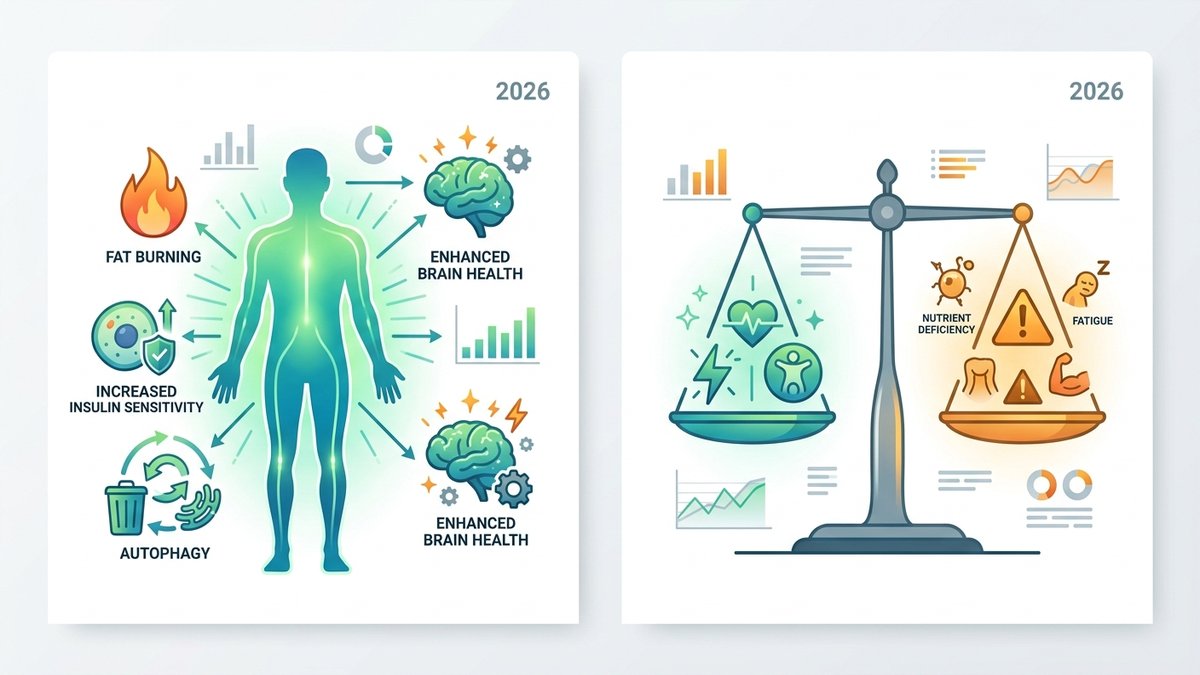
The science on intermittent fasting benefits has matured considerably over the past decade. We now have robust human clinical trial data — not just animal studies — supporting IF's positive effects on weight, metabolic markers, inflammation, brain health, and even longevity pathways. A 2019 review in *The New England Journal of Medicine* by Mattson et al. outlined multiple mechanisms: metabolic switching, reduction in oxidative stress, improved insulin sensitivity, enhanced autophagy (cellular self-cleaning), and favorable changes in gut microbiome diversity. A 2024 meta-analysis in *Obesity Reviews* analyzing 27 randomized controlled trials found that IF reduced fasting insulin levels by an average of 14–21% and fasting blood glucose by 3–8 mg/dL — clinically meaningful changes, especially for people at risk of type 2 diabetes. Cognitive benefits are also gaining scientific traction, with brain-derived neurotrophic factor (BDNF) — a key protein for memory and learning — increasing measurably during fasted states.
However, the risks of intermittent fasting deserve equal attention, especially as the practice becomes more mainstream and less medically supervised. The most significant alarm bell came from a 2024 American Heart Association (AHA) preliminary research study (presented at their epidemiology conference) which found that people following an 8-hour time-restricted eating window had a 91% higher risk of cardiovascular death compared to those eating across 12–16 hours. This study was observational — not a controlled trial — meaning it couldn't prove causation, and many nutrition scientists noted significant methodological limitations. Still, it underscores the importance of medical supervision, especially for people with pre-existing cardiovascular conditions. Other documented risks include nutrient deficiencies if the eating window is poorly planned, disordered eating triggers for vulnerable individuals, hormonal disruptions in women (particularly affecting the hypothalamic-pituitary-ovarian axis), and reduced athletic performance if fasting windows conflict with training schedules.
Pros
- ✅ Weight & fat loss: Meta-analyses show IF produces 0.8–13% body weight reduction — comparable to continuous calorie restriction with higher long-term adherence.
- ✅ Insulin sensitivity: IF improves insulin sensitivity by 14–31% in at-risk adults, reducing type 2 diabetes risk significantly (Cell Metabolism, 2022).
- ✅ Cellular autophagy: Fasting activates autophagy — the body's cellular recycling process — linked to reduced cancer risk and slower aging (Nobel Prize-winning research, 2016).
- ✅ Brain health: Fasting increases BDNF production and may reduce risk of neurodegenerative diseases like Alzheimer's and Parkinson's, per *Nature Reviews Neuroscience*.
Cons
- ❌ Cardiovascular concern: A 2024 AHA preliminary study linked 8-hour TRE to a 91% higher risk of cardiovascular death — though the study's observational design limits conclusions.
- ❌ Hormonal disruption in women: Some research suggests aggressive IF protocols may disrupt menstrual cycles and cortisol regulation in women, particularly those with low body fat.
- ❌ Muscle loss risk: Without adequate protein intake and resistance training, prolonged fasting periods can trigger muscle catabolism, especially in older adults over 60.
⚠️ Important warning: Intermittent fasting is NOT appropriate for pregnant or breastfeeding women, individuals with a history of eating disorders, people with type 1 diabetes managing insulin dosing, or children and adolescents. Always consult a licensed healthcare provider before starting any fasting protocol, especially if you take prescription medications.
✅ Who Should (and Shouldn't) Try Intermittent Fasting in 2026
Intermittent fasting is genuinely one of the most accessible metabolic health tools available in 2026 — it costs nothing, requires no special foods or equipment, and can be adapted to almost any lifestyle. The ideal candidate for IF is a generally healthy adult (ages 18–65) who wants to improve weight management, metabolic markers, energy levels, or longevity, and who doesn't have a history of eating disorders or complex hormonal conditions. Research suggests IF tends to work particularly well for individuals with insulin resistance, prediabetes, obesity-related metabolic syndrome, or those who simply eat too frequently throughout the day due to habit rather than hunger. A 2023 *JAMA Internal Medicine* trial found that adults with obesity who followed a 16:8 protocol for 12 months lost an average of 8.0 kg (17.6 lbs) compared to 6.3 kg (13.9 lbs) in the control group — a meaningful real-world difference without calorie counting. Men and postmenopausal women tend to show the most consistent and dramatic benefits from standard IF protocols, according to current evidence.
Conversely, certain populations should approach IF with significant caution or avoid it altogether. Women of reproductive age are a nuanced group — some studies show IF is perfectly safe and effective, while others indicate that very long fasting windows (18+ hours) can elevate cortisol, disrupt estrogen and progesterone levels, and affect cycle regularity. A conservative 12–14 hour overnight fast is generally considered safe for most women. Older adults over 65 should be particularly cautious about muscle preservation — sarcopenia (age-related muscle loss) is already a serious health concern, and aggressive fasting without adequate protein and resistance training can accelerate it. Athletes with high training volumes may find that fasting conflicts with performance and recovery needs, though fasted morning cardio within a moderate IF window has shown benefits for fat adaptation in endurance sports. Personalization, medical guidance, and listening to your body remain the non-negotiables of safe IF practice in 2026.
❓ Frequently Asked Questions
✍️ Final Thoughts: Your Next Step With Intermittent Fasting in 2026
Intermittent fasting remains one of the most powerful, evidence-backed, and accessible metabolic health strategies available in 2026 — but like any health intervention, it works best when approached with knowledge, intention, and personalization. The benefits are real and well-documented: improved insulin sensitivity, meaningful weight and fat loss, activated cellular repair through autophagy, better brain health via BDNF elevation, and favorable changes in cardiovascular risk markers like triglycerides and blood pressure. The risks are also real — particularly for women with hormonal sensitivities, older adults concerned about muscle mass, those with cardiovascular disease, and anyone with a history of disordered eating. The 2024 AHA observational data was a wake-up call worth heeding, not as a reason to abandon IF, but as a reminder that *how* you fast matters as much as *whether* you fast. The best protocol is one you can sustain for months and years — not the most extreme version you can white-knuckle through for a few weeks. Start with 16:8, prioritize protein and whole foods in your eating window, track non-scale victories, and give it a genuine 8–12 week trial before making any judgments about effectiveness.
So what should you do right now, today? Start by tracking your current eating window for one week without changing anything — just observe. Download a free app like Zero or Fastic, log your first and last bite of food each day, and see where your natural fasting window already sits. You might be surprised to find you're already fasting 11–12 hours without realizing it. From there, extend that window by 30 minutes every 4–5 days until you hit your target. Book an appointment with your primary care physician or a registered dietitian before making significant changes — especially if you're on medications, managing a chronic condition, or have any cardiovascular history. In 2026, there are more resources, apps, continuous glucose monitors, and evidence-based coaching programs than ever before to support your IF journey. The path to better metabolic health doesn't have to be complicated or expensive — it might start with simply delaying breakfast by an hour. Take the first step today, and trust the process. Visit InfoWellHub.com for more evidence-based wellness guides to support your health goals every step of the way.
Post a Comment