
📌 Table of Contents ⬆
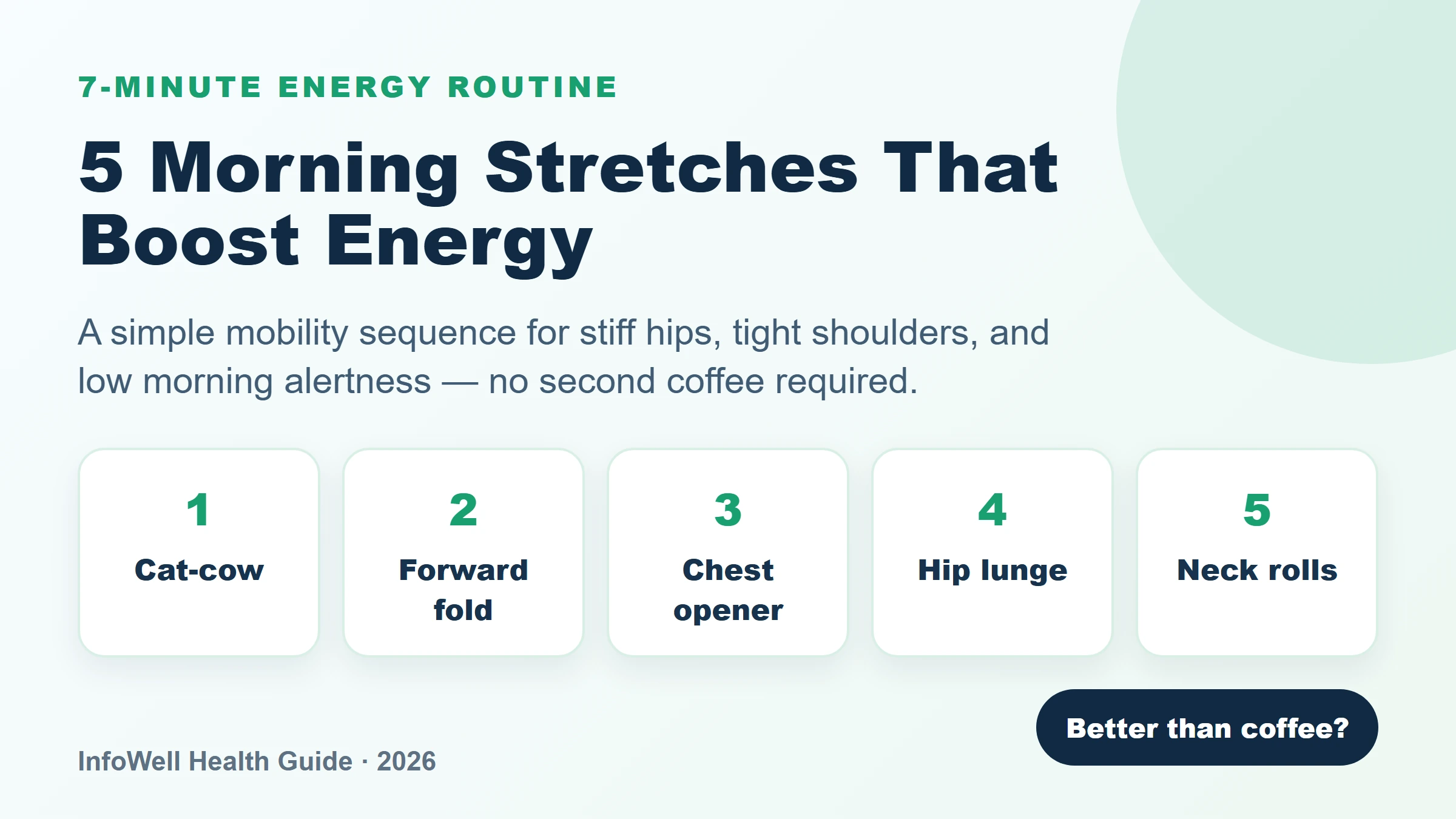
5 morning stretches that boost energy work best when you use them as a 7-minute mobility sequence, not as random moves between checking your phone and rushing to the kitchen. This version is designed for readers who want a practical alternative to a second cup of coffee and who wake up with stiff hips, tight shoulders, or low back tension.
Before you start: choose your next step
Use this article as step 1 of a morning-energy loop. After the stretches, keep moving through the routine below instead of leaving after one page.
- Step 1: Do the 7-minute stretch sequence on this page.
- Step 2: Add a short walk with the daily walking guide.
- Step 3: Fix recovery with the magnesium sleep guide.
Quick routine at a glance
- Cat-cow stretch — 2 minutes
- Standing forward fold — 1 minute
- Chest opener stretch — 1 minute
- Hip flexor lunge — 2 minutes
- Neck rolls and shoulder shrugs — 1 minute
Why morning stretches beat coffee for steady energy
Stretching increases circulation, raises body temperature gradually, and helps your nervous system shift out of sleep inertia. Coffee can still help, but relying on caffeine alone does nothing for the physical stiffness that makes many people feel foggy in the first hour of the day.
The difference maker is consistency. A short mobility routine done daily usually feels better than an occasional 30-minute workout followed by six sedentary mornings in a row.
1. Cat-cow stretch (2 minutes)
Start on all fours with your hands under your shoulders and knees under your hips. Inhale as you drop your belly and lift your chest. Exhale as you round your spine and tuck your chin.
Why it helps: cat-cow is a low-risk way to wake up the spine, especially if you slept curled up on your side.
2. Standing forward fold (1 minute)
Stand with soft knees, hinge forward, and let your head and arms hang. Do not force the stretch. The goal is to decompress the back of the body and encourage calm breathing, not to prove flexibility.
Common mistake: locking the knees and yanking yourself deeper. That usually turns a restorative move into a hamstring strain risk.
3. Chest opener stretch (1 minute)
Clasp your hands behind your back or place your forearms against a doorway and gently open your chest. This is especially useful if you wake up rounded forward from side sleeping or laptop posture.
4. Hip flexor lunge (2 minutes)
Step one foot forward into a split stance, lower into a gentle lunge, and tuck the pelvis slightly so you feel the stretch at the front of the rear hip. Hold and switch sides.
If you sit for long hours, this is often the highest-value move in the whole sequence. Tight hip flexors can make walking feel heavy and can contribute to the “sluggish legs” feeling many people blame on poor sleep alone.
5. Neck rolls and shoulder shrugs (1 minute)
Finish with gentle neck circles, shoulder rolls, and a few slow shrugs. Keep the range small and controlled. The purpose is to release overnight tension, not crank the neck through extreme angles.
7-minute stretch tracker
| Move | Time | What to notice | Next action |
|---|---|---|---|
| Cat-cow | 2 min | Back stiffness easing | If still stiff, repeat once |
| Forward fold | 1 min | Hamstrings and low back | Keep knees soft |
| Chest opener | 1 min | Breathing depth | Pair with daylight |
| Hip flexor lunge | 2 min | Desk-sitting tightness | Walk after stretching |
| Neck/shoulders | 1 min | Tension level | Check sleep quality if fatigue remains |
How to turn these 5 morning stretches into a real 7-minute routine
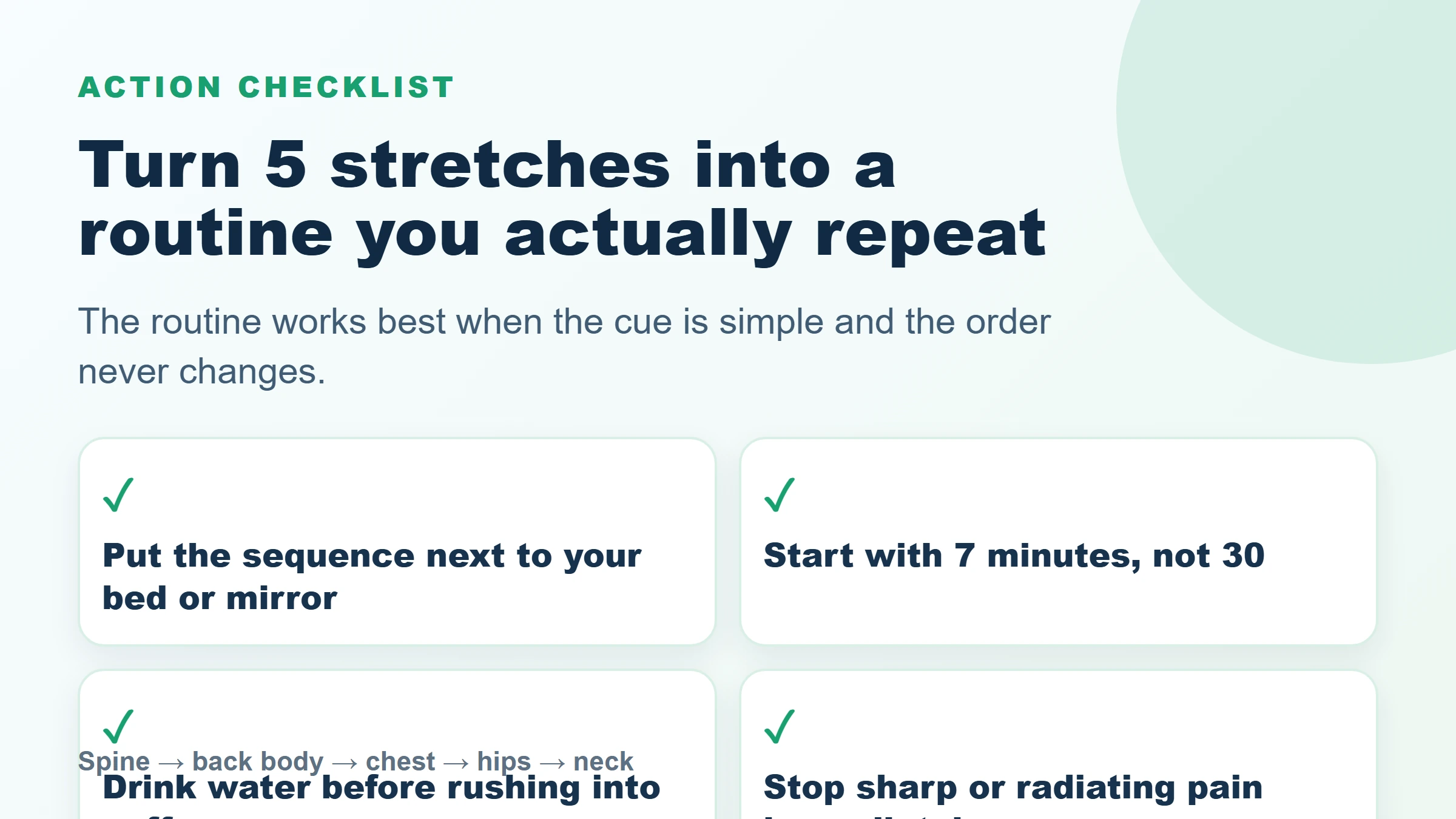
Move in this order: spine first, back body second, chest third, hips fourth, neck and shoulders last. That sequence tends to feel smoother than jumping randomly between upper- and lower-body stretches.
Feeling awake but still low-energy?
That usually means stiffness was only one part of the problem. After this section, open the walking guide and build a two-part morning routine.
Read next: walking 10,000 steps dailyThe science behind morning stretching
Morning movement can improve perceived alertness because it increases blood flow and reduces mechanical stiffness after long periods of inactivity. It also pairs well with daylight exposure, hydration, and a short walk. If you want to extend the energy benefit beyond these stretches, add a daily walking routine later in the day instead of reaching for more caffeine.
For readers whose fatigue is tied to poor sleep quality, mobility alone may not be enough. In that case, compare your morning routine with your nighttime recovery habits, including magnesium intake and sleep timing. Our guide to the best magnesium supplements for sleep may help if recovery is the bigger bottleneck.
When morning stretches are not enough
If energy crashes are driven by irregular eating, dehydration, or aggressive dieting, morning mobility should be part of the solution, not the whole solution. Readers using time-restricted eating often do well with this routine because it creates alertness before the first meal. If that is your setup, see our intermittent fasting for beginners guide for a sustainable starting framework.
Differentiation point: most quick stretch articles stop at listing moves. The real win is matching the stretches to the reason you feel low energy—stiff spine, desk posture, tight hips, poor sleep, or under-recovery.
FAQ
How long should I stretch in the morning?
Seven to ten minutes is a strong target. Five minutes is still enough to reduce stiffness and improve focus if you do it consistently.
Should I stretch before or after breakfast?
Most people do well before breakfast because the routine is short and gentle. If you feel light-headed in the morning, drink water first and keep transitions slow.
Can morning stretches replace exercise?
No. They improve mobility and help you feel better early in the day, but they do not replace cardio, strength training, or daily walking.
What if I feel pain during a stretch?
Back off immediately. Mild pulling is normal; sharp, pinching, or radiating pain is not. If symptoms repeat, stop the movement and get professional guidance.
What is the best stretch for people who sit all day?
The hip flexor lunge and chest opener usually offer the fastest payoff because sitting tends to shorten the front of the hips and pull the shoulders forward.
Keep building your morning energy plan
If stiffness is only one part of your low-energy problem, these next guides help you fix the rest of the routine.
Conclusion
These 5 morning stretches that boost energy work because they solve a physical problem first: stiffness after hours of sleep. Start with the 7-minute sequence, repeat it for one week, and then decide whether you need more caffeine—or simply a better morning mobility cue.
Build a repeatable morning energy loop
Most readers do not need more stretch variations; they need a small loop that is easy to repeat before the day becomes noisy. Use this simple sequence as a habit bridge: wake up, drink water, complete the 7-minute mobility flow, then take a short walk if time allows.
- Low-energy morning: keep the sequence slow and pair it with daylight or a brief walk.
- Tight hips or back: spend the extra minute on the hip flexor lunge and cat-cow stretch.
- Desk-work day: save the chest opener as a midday reset so the article supports return visits.
- Next step: connect mobility with sleep quality, magnesium, walking, and fasting habits instead of treating stretches as a one-off trick.
For the next health habit, continue with the daily walking guide, magnesium for sleep recovery, and intermittent fasting for beginners.
Post a Comment